


Picture a Navy veteran in a brick rancher in Chesterfield. A layoff in the spring put her four payments behind, and now the servicer’s letters come every week. She calls and asks about the new VA program she read about, and the rep tells her it isn’t available yet. She hangs up thinking the door is closed. It isn’t, and a federal deadline at the end of this month is a big part of why. If you’re behind on a VA loan in Richmond or anywhere in Virginia, you have more ways out of a VA home loan foreclosure than that phone call made it sound.
Why Are So Many VA Borrowers Confused Right Now?
The rules changed twice in about a year. VA ended its old rescue option, the VA Servicing Purchase program, on May 1, 2025, according to NPR’s October 30, 2026 report. Congress then passed the VA Home Loan Program Reform Act, signed July 30, 2025, which told VA to build a new tool called a partial claim.
VA opened that program to servicers in June 2026. Servicers, the companies that collect your payment, didn’t all switch it on at once. VA’s own help page for borrowers who are behind says servicers have until November 28, 2026, to add partial claims to their systems. NPR reported on October 30 that most servicers still weren’t offering it.
So two veterans with the same problem can hear two different answers. One servicer says yes. Another says not yet. “Not yet” is not the same as “no.”
Here’s what I’d tell anyone in that spot. Write down the date of every call, the name of the person you spoke with, and what they said. If you’re getting nowhere, read our guide on how to stop or avoid foreclosure in Richmond, which walks through the local process step by step.
What Is the VA Partial Claim Program?
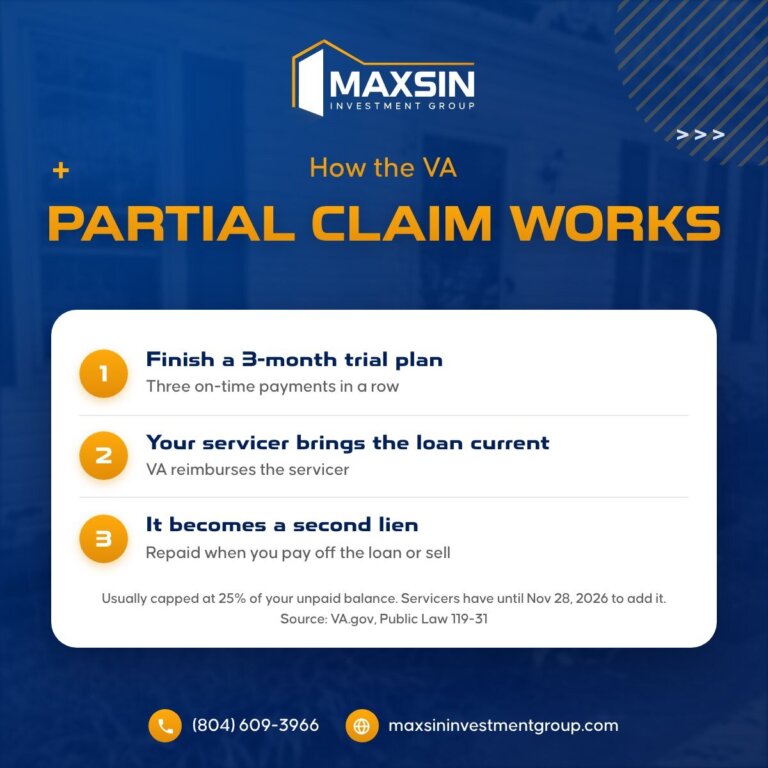
A partial claim is money VA puts toward your missed payments so your loan is current again. You don’t pay it back monthly. Per VA, you repay it when you pay off the loan or sell the home.
The law sets a ceiling. A partial claim generally can’t be more than 25 percent of your unpaid loan balance. If you missed a payment between March 1, 2020 and May 1, 2025, the cap is 30 percent. On a $280,000 balance, 25 percent works out to $70,000, which is far more than most people are behind.
There’s a catch, and it’s a fair one. You have to finish a three-month trial payment plan first, making three on-time payments in a row. Your servicer then brings the loan current, VA reimburses the servicer, and that amount becomes a second lien on the house. A second lien is just a claim on the property that sits behind your main mortgage.
That second lien matters later. If you sell the house, the partial claim gets paid out of the sale before you see a dollar. It’s not a gift. It’s a pause button that you settle when the house changes hands.
The program also can’t fix a payment you simply can’t afford going forward. It only covers what you’ve already missed. If your monthly payment itself is the problem, the next sections matter more.
How Much Time Do You Have Before a Virginia Foreclosure?
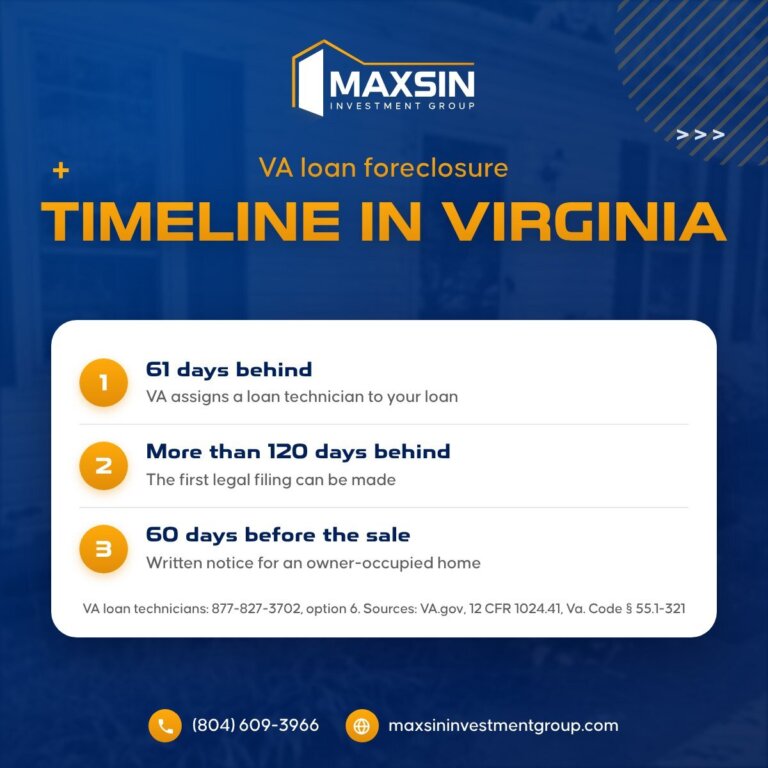
Less than most people think, but more than the panic suggests. Under the federal servicing rule, 12 CFR 1024.41(f), a servicer generally can’t make the first legal filing until you’re more than 120 days behind. That’s about four missed payments.
VA adds its own safety net. Once a VA-guaranteed loan is 61 days past due, VA automatically assigns a loan technician to review it. You can call those technicians yourself at 877-827-3702 and select 6, Monday through Friday, 8 a.m. to 6 p.m. Eastern. They’ll talk with you even if you’re nervous about calling your servicer.
After that, Virginia moves fast. Most Virginia homes are sold by a trustee without a court case, under the deed of trust you signed at closing. A trustee is a neutral party named in that document who can sell the property if the loan isn’t paid. For an owner-occupied home, Virginia Code § 55.1-321 requires written notice at least 60 days before the sale.
Sixty days sounds like a lot. It isn’t, once you add in a buyer’s inspection, a title search and a closing date. The best time to make a plan is before that 60-day letter arrives, not after.
What If a Loan Modification Raises Your Payment?
This is the part of the VA story that surprises people. A loan modification changes the terms of your loan so the missed amount gets folded in. VA offers a traditional modification, a 30-year modification and a 40-year modification.
The problem is the interest rate. Many VA borrowers bought or refinanced at rates near 3 percent. A modification today can reset that rate higher, and a longer term doesn’t always make up for it. NPR reported that more than 15,000 veterans whose VA loans were modified saw their monthly payment go up by at least $150.
That doesn’t make modification a bad choice. For a veteran with steady income who just hit one rough stretch, it can be exactly right. It just means you should ask for the new payment in writing before you sign anything. Do the math at the kitchen table.
Have you asked your servicer which options you’re being evaluated for, and in what order? That one question can save you from accepting the first offer by default. A HUD-approved housing counselor can sit with you and compare the numbers for free. I’m not a lawyer or a financial advisor, and for anything legal, a Virginia real estate attorney is the right call.
If the honest answer is that the house no longer fits your budget, that’s not a failure. It’s information.
What Happens to Your VA Benefit If You Sell, Short Sell or Lose the House?
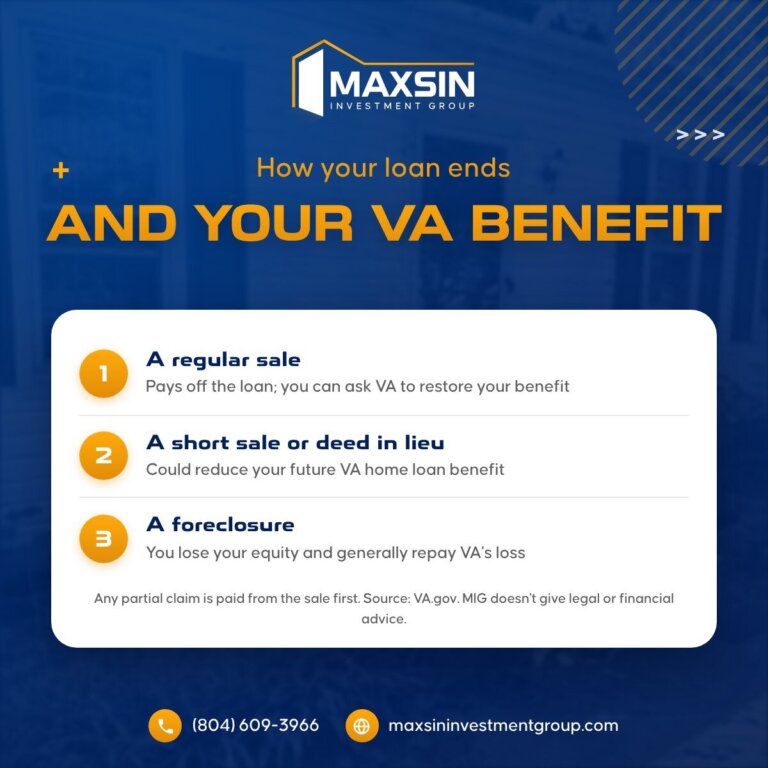
Your VA home loan benefit, which VA calls entitlement, is the part of the program that lets you buy with little or no money down. How your current loan ends decides how much of it you get back.
According to VA, a short sale or a deed in lieu of foreclosure could reduce your future home loan benefit. A short sale is when the lender accepts less than you owe. A deed in lieu is when you sign the house over to the lender to avoid the auction. After a foreclosure, short sale or deed in lieu, you generally have to repay what VA lost before that benefit is fully restored.
A regular sale is different. If the sale pays your loan off in full, you can ask VA to restore your entitlement and use it again later. VA’s loan technicians can tell you exactly where you stand.
Now look at what equity means here. In September 2026, the median Richmond home sold for $401,199, according to Redfin’s Richmond market data. Homes there sold after a median of 17 days on the market. If you owe less than your house is worth, a sale can pay off the loan, settle any partial claim and leave money in your pocket. A foreclosure can wipe out all of that.
That’s why I’d rather see a veteran sell on their own terms than wait for a trustee to do it for them. If your house is just outside the city, you can see how we buy houses in Chesterfield, VA, as-is, on a closing date you pick.
Can You Stop a VA Home Loan Foreclosure in Virginia?
Yes, and in most cases you have more than one way to do it. Which one fits depends on whether you want to keep the house and whether you can afford the payment going forward.
If you want to stay and your income has recovered, push for the partial claim. Ask your servicer, in writing, whether it’s offering partial claims yet, and if not, on what date it will. If you’re told no, ask whether the answer means you don’t qualify or the system isn’t ready. Those are very different answers.
If a modification is on the table, compare the new payment against your budget before you accept it. A repayment plan or special forbearance can also work if you’re only a few payments behind.
If keeping the house no longer makes sense, VA says servicers can give you extra time to arrange a private sale. That’s a regular sale on your timeline, and it’s usually the way to protect both your equity and your benefit. You can list with an agent if you have time and the house shows well. Honestly, that often brings the highest price.
One warning before you sign anything. Letters from strangers offering to save your house tend to show up right after a foreclosure notice. Virginia’s foreclosure rescue law, § 59.1-200.1, bars those companies from taking a fee before they’ve finished the work or before a sale settles. A promise that you can buy the house back later only counts if it’s in a written contract with the price spelled out. Never deed your house to someone you just met.
If the house needs work, you’re short on time, or you’d rather skip showings, a cash sale is another route. Here’s how it works when you sell to us: one walkthrough, a written offer, and a closing date that fits the foreclosure clock. Whatever you choose, choose it while you still have time to choose.
Frequently Asked Questions
Is My Servicer Required to Offer the VA Partial Claim?
VA says servicers have until November 28, 2026, to add partial claims to their systems. Until then, some servicers may tell you it isn’t available. If you’re turned down, ask whether it’s because you don’t qualify or because the servicer isn’t set up yet. If you can’t get a clear answer, VA’s loan technicians at 877-827-3702, option 6, can step in.
When Do I Have to Pay Back a VA Partial Claim?
You don’t make monthly payments on it. Per VA, you repay it when you pay off the loan or sell the home. It’s recorded as a second lien, so it gets paid from the sale before any money comes to you.
Can I Sell My House If I’m Behind on a VA Loan?
Yes. You own the house until the trustee’s sale, so you can sell it while you’re behind. VA says servicers can delay foreclosure to give you time for a private sale. The sale pays off the loan at closing. Our guide to selling a house in foreclosure in Virginia covers the timing in detail.
Will a Short Sale or Deed in Lieu Hurt My VA Benefit?
It can. VA says both could reduce your future home loan benefit, and you generally have to repay VA’s loss to fully restore it. A regular sale that pays the loan off in full usually leaves you in a better position to use your benefit again.
What Happens If a VA Loan Goes to Foreclosure?
The trustee sells the house, and you lose any equity left in it. VA says you generally have to repay what VA lost before your home loan benefit is fully restored. For loans closed on or after January 1, 1990, VA says you only owe VA for foreclosure costs if it finds fraud, misrepresentation or bad faith. That’s why getting ahead of the sale matters so much.
Does VA Help If My Loan Isn’t VA-Guaranteed?
Yes, in part. VA says veterans and surviving spouses can get counseling from its loan technicians even if their mortgage isn’t a VA loan. The partial claim itself only applies to VA-guaranteed loans.
Where That Leaves You
Being behind on a VA loan right now is confusing, but it’s not hopeless. The partial claim is real, the servicer deadline is November 28, and Virginia still gives owner-occupants written notice before any sale. Use that time to get answers in writing and compare your options side by side.
If you’d like a second set of eyes on your numbers, reach out to us at (804) 609-3966. If keeping the house or listing it makes more sense, I’ll tell you that plainly. No pressure, no obligation.
Helpful Virginia Blog Articles
Can You Sell a House in Foreclosure in Virginia Before Auction
Can You Sell a House With Back Taxes in Richmond, VA
Stop or Avoid Foreclosure in Richmond, Virginia